A roof rarely fails without warning. The trick is knowing which warnings mean “patch this now” and which mean “this system is finished”. Here is exactly how we make that call on a home, and what you should ask any contractor who makes it for you.
Start with what the roof is telling you
Before anyone climbs a ladder, there is useful evidence at ground level. Walk the perimeter and look up at the same time of day the sun rakes across the roof — side light exaggerates every irregularity.
- Granules in the gutter or at the downspout base. Some granule loss is normal weathering. Drifts of it after a windy week usually mean the shingles are shedding their protective surface.
- Curling, cracking or missing tabs. Localised lifting is often repairable. Tabs curling across a whole slope is a material that is past its serviceable life.
- Dark patches or soft spots on the ceiling. This is the urgent category. Water is already through the decking, and the longer it stays, the more of the structure it touches.
- Rust, pitting or granules staining the flashing. Flashing and pipe boots often fail before the shingles do — and those are genuinely repair-sized jobs.
- Sagging ridgelines or a wavy roof plane. That points at the structure beneath, not the covering, and it changes the conversation entirely.
The question is never simply “repair or replace?” It is “what will still be watertight a decade from now, and what will not?”
Repairs that honestly make sense
We recommend a repair when the failure is local, the surrounding material has useful life left in it, and no other part of the roof is being compromised. In practice that means:
{check_list([ 'A single damaged slope after a storm, with the rest of the roof sound', 'Failed pipe boots, vents or counter-flashing at a chimney', 'Cracked sealant or a lifted ridge cap letting wind-driven rain in', 'A leaking valley that can be re-laid without disturbing the full covering', 'Ice-dam or gutter-related water entry that is solved by drainage work', ])}A repair is only as good as the investigation behind it. Ours includes photographs of everything we find in the attic and on the deck, so you can see the cause rather than just the symptom.
How we inspect a roof
Every roofing upgrade begins with a documented inspection rather than a price. We check:
- Shingle condition across each slope, including the shaded north side
- Decking integrity and any soft spots under the covering
- Underlayment, valleys, ridges and every penetration
- Flashing at walls, chimneys and skylights
- Attic ventilation, insulation contact and signs of condensation
- Gutter capacity, run-off and drainage away from the foundation
When replacement is the honest answer
Replacement is the right recommendation when repairs would be repeated spending on the same problem. The usual signals:
- The roof is approaching the end of its expected service life and several slopes are failing at once.
- Underlayment has failed, so the covering is no longer the weakest link — it is the second-weakest.
- You are planning solar panels, a rooftop addition or new insulation, and lifting the roof afterwards would undo that investment.
- Repeated leaks in different locations, which usually means the whole assembly is tired.
- You are selling, or buying, and want no ambiguity for an inspector.
A full upgrade is not just new material. It is a system: deck repair, underlayment, ice-and-water protection in vulnerable zones, new flashing, correct fastening and ventilation that lets the roof dry from underneath.
How the roof connects to everything else
This is where a multi-service renovation studio earns its keep — the roof is rarely an isolated decision. Three examples we see constantly:
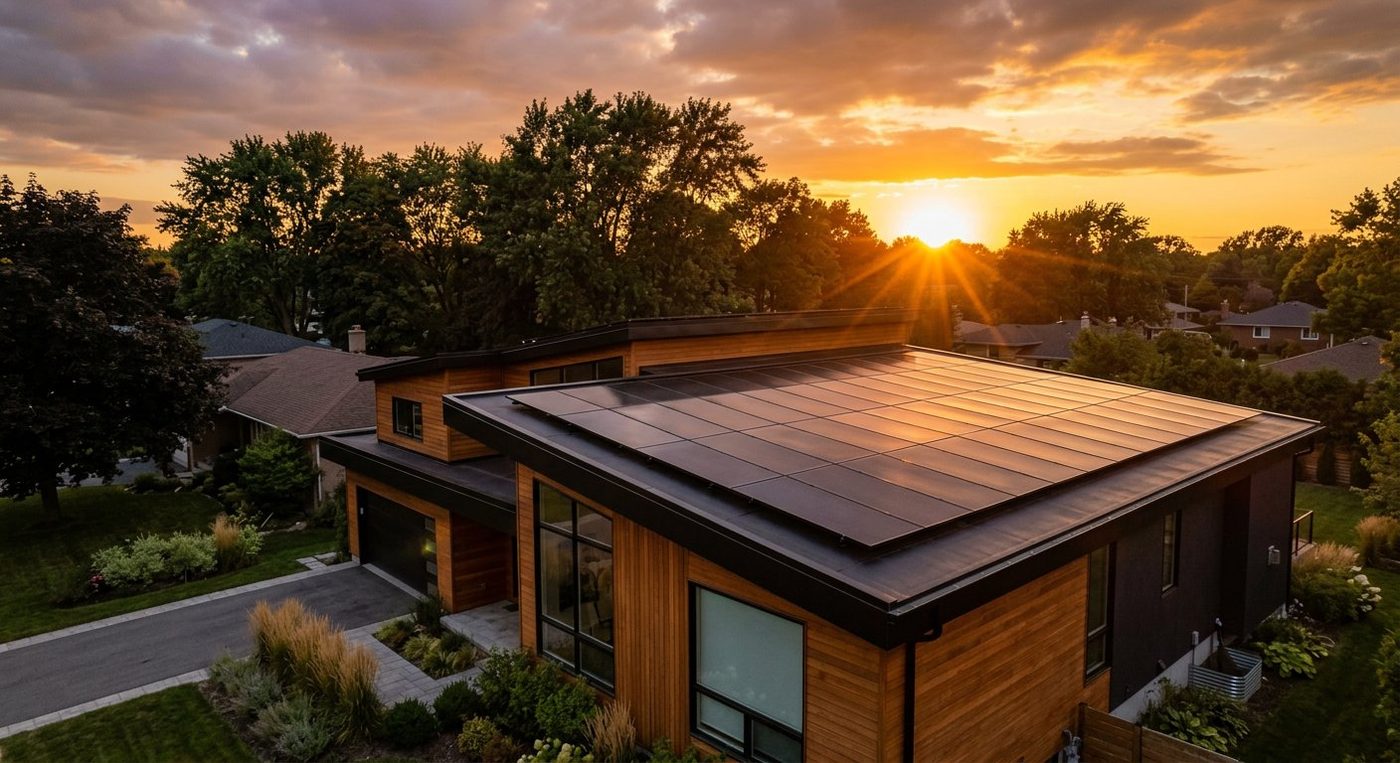
- Solar. Panels should be installed on a roof that will outlast them. Re-roofing first avoids paying to remove and refit an array later.
- Insulation and ventilation. Sealing an attic without correcting ventilation traps moisture, which shortens roof life. These are one job, not two.
- Gutters and grading. A roof is only as good as the water path at its edge. Overflow at the foundation is what turns a roofing problem into a basement problem.
A useful order of operations
Structure and envelope first, energy upgrades second, interiors last. New flooring and paintwork should never be installed beneath work that will later disturb the ceiling above it.
Ask any roofer these questions
- Can I see photographs of what you found, including the decking?
- Will you repair, recover or fully tear off — and why that choice here?
- What underlayment and flashing details are included, and where?
- How will the attic be ventilated afterwards?
- What does your workmanship warranty cover, and for how long in writing?
- Who is on site, and who is my contact if it rains for a week?
A contractor who welcomes these questions is a contractor who has done the thinking. If the answers change once work begins, that is your signal to slow down.